
When electric vehicles first hit the mainstream, the narrative was entirely dictated by range anxiety. Drivers wanted to know one thing: How far can I go on a single charge?
Today, the conversation has fundamentally shifted. As EV adoption scales across commercial fleets and passenger vehicles alike, the bottleneck—and the innovation—has moved from the car’s battery pack to the charging ecosystem itself.
Understanding the next wave of EV charging technology is vital for station operators, fleet managers, and EV drivers alike. Let’s look under the hood at the core breakthroughs defining the future of EV charging infrastructure.
1. Ultra-Fast and Megawatt Charging (MCS)
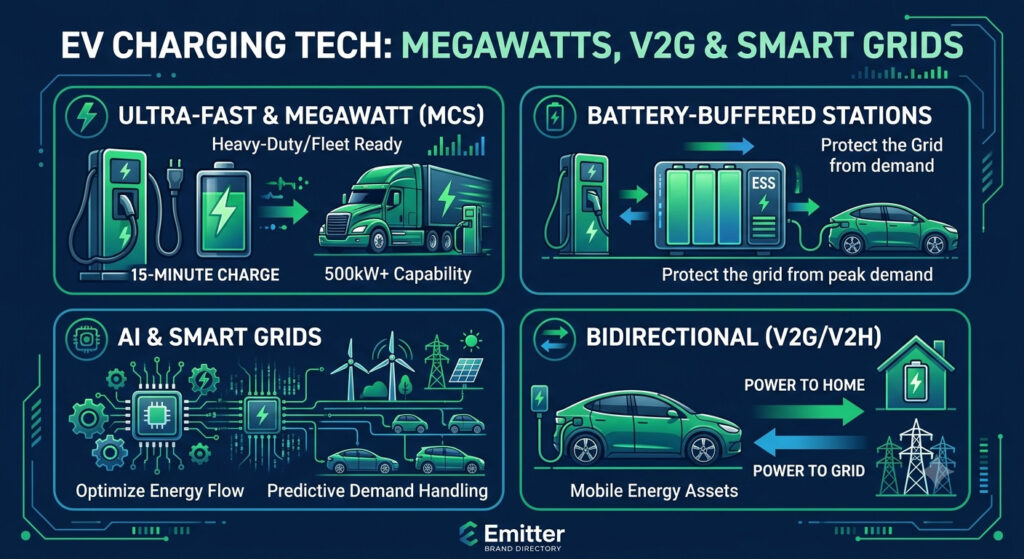
The days of waiting hours at a public stall are rapidly fading. While 50 kW DC fast chargers were once considered cutting-edge, the industry standard is shifting aggressively toward ultra-fast architectures exceeding 350 kW, with some next-generation systems scaling up to 500 kW and beyond.
For heavy-duty commercial transport and high-capacity passenger fleets, Megawatt Charging Systems (MCS) are moving out of the blueprint phase and into real-world pilot deployments. These systems deliver massive power throughput, capable of replenishing commercial trucks and large battery-pack vehicles in the time it takes a driver to grab a quick break.
2. Battery-Buffered Charging Stations
As charging speeds increase, local electrical grids face unprecedented strain. Upgrading transformers and substations for every high-power DC fast charger is expensive and time-consuming.
Enter battery-buffered charging infrastructure. By integrating large stationary energy storage systems (ESS) directly into charging hubs, operators can store energy slowly from the grid during off-peak hours and discharge it rapidly to vehicles during peak demand. This design protects operators from high peak-demand utility tariffs and enables ultra-fast charging sites even in grid-constrained locations.
3. AI-Driven Smart Energy Management
Power distribution is no longer a static mechanical process; it’s an intelligent network. Artificial intelligence and machine learning algorithms are increasingly being deployed behind the scenes to:
-
Predict Peak Demand: Balance local grid loads dynamically based on historical usage patterns and traffic flow.
-
Mitigate Demand Charges: Smooth out power curves to keep operational overhead manageable for site owners.
-
Enable Dynamic Pricing: Adjust charging costs in real time based on renewable energy availability and grid strain, rewarding drivers who plug in during green energy surpluses.
4. Bidirectional Charging: V2G and V2H
An electric vehicle is no longer just a power consumer—it’s a mobile energy asset. Vehicle-to-Grid (V2G) and Vehicle-to-Home (V2H) technologies are maturing into commercial realities.
When plugged into a compatible bidirectional charger, modern EVs can feed stored electricity back into a home during a blackout or support grid stability during periods of high demand. For fleet owners, this opens up brand-new revenue streams, transforming idle parked vehicles into virtual power plants.
5. Charging Hubs Evolving Into Destination Ecosystems
As charging times shrink toward the 15-to-20-minute mark, user expectations are evolving. Drivers no longer want to sit in an isolated parking lot staring at a concrete wall.
Modern charging hubs are transforming into service-oriented destinations. High-power hubs feature high-speed Wi-Fi, solar-canopy lounges, food and beverage retail, and automated amenities, making the charging stop a seamless part of the daily routine rather than an inconvenience.