
Driving an electric vehicle is a revolutionary experience, offering a quiet ride, instant torque, and zero tailpipe emissions. But for many new and prospective EV owners, transitioning from the simplicity of a gas station to the diverse landscape of EV charging stations can feel overwhelming.
The question isn’t if you can charge, but rather where and how fast.
At Emitter, we understand that reliable infrastructure is the key to electric mobility. That’s why we’ve built the most comprehensive EV charging station directory. This guide will walk you through everything you need to know about the different types of chargers, the plugs they use, and how to seamlessly navigate the charging network.
Let’s plug into the details.
1. Level 2 Charging: The Foundation of Daily Power
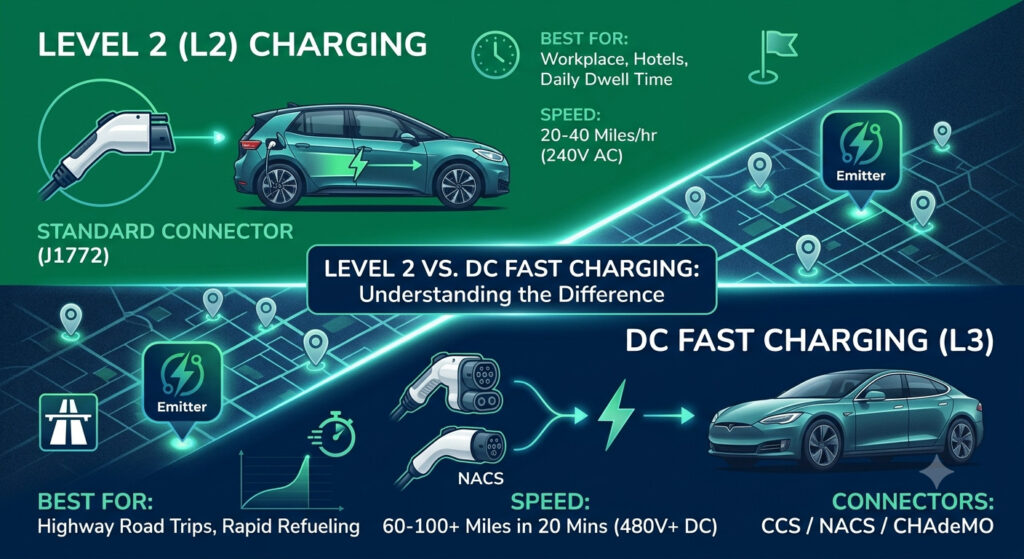
Level 2 (L2) charging is the most common form of EV charging you will encounter in public and at home. It uses 240-volt AC electricity (the same type of outlet as a clothes dryer).
What You Need to Know:
-
Speed: Typically adds 20 to 40 miles of range per hour of charging. It’s not meant for quick pit stops but rather for “dwell time” charging.
-
Best Use Case: Perfect for workplace charging, shopping centers, hotels, and multi-unit residential buildings. You plug in and go about your day (or night), returning to a significantly charged battery.
-
The Standard Connector: In North America, the SAE J1772 (or ‘J-Plug’) is the universal standard for all non-Tesla EVs. It’s a round plug with five pins.
2. DC Fast Charging (Level 3): The Road Trip Game Changer
Direct Current (DC) Fast Charging, often referred to as Level 3, is the key to enabling long-distance EV travel. Unlike L2, which must convert AC power from the grid into DC power for the battery, DC Fast Chargers bypass the car’s onboard converter and feed electricity directly to the battery pack.
What You Need to Know:
-
Speed: This is where things get impressive. Depending on the station’s power output (measured in kW) and your vehicle’s capability, DC Fast Chargers can add 60 to 100+ miles of range in as little as 10 to 30 minutes.
-
Best Use Case: Essential for highway road trips, drivers who don’t have home charging, or fleet vehicles that need quick turnarounds.
-
The Connector Confusion: This is where it gets a little complicated. There are three main types of DC Fast Charging plugs:
-
CCS (Combined Charging System): The most common standard for European and North American automakers (excluding Tesla, historically). It looks like a J1772 plug with two large DC pins added at the bottom.
-
NACS (North American Charging Standard): Originally proprietary to Tesla, this compact plug handles both AC (Level 2) and DC (Fast Charging). Most major automakers are transitioning to this plug, and existing CCS vehicles can often use it with an adapter.
-
CHAdeMO: An older Japanese standard, primarily found on the Nissan LEAF. It’s a large, round plug and is slowly being phased out in new vehicles.
-
“DC Fast Chargers can add 60 to 100+ miles of range in as little as 10 to 30 minutes.”
3. Navigating the Charging Networks
Unlike a single type of gas station, EV charging infrastructure is managed by dozens of different charging networks (e.g., EVgo, Electrify America, ChargePoint, Flo).
Each network has its own app, membership plan, and pricing structure. This fragmentation is one of the biggest pain points for drivers.
The Problem:
-
You arrive at a charger only to find it requires a different app you haven’t downloaded.
-
You discover that one network is significantly more expensive than another, even though they use the same power output.
-
Worst of all: The charger you counted on is out of service.
The Emitter Solution:
This is why Emitter exists. Our directory isn’t just a static map; it’s an intelligent platform that simplifies the ecosystem.
-
Unified Map: See stations from all networks in one cohesive view.
-
Network Filtering: Filter by your preferred network or by those that accept credit cards without an app.
-
Connector Specificity: Verify that a station has the exact plug type your car requires (e.g., CCS vs. NACS).
-
Real-Time Reliability Data: We aggregate driver reports and station health data so you don’t have to guess if a charger is operational.
Quick Reference: The EV Charging Station Cheat Sheet
| Feature | Level 2 (L2) Charging | DC Fast Charging (Level 3) |
| Voltage | 240V AC | 480V+ DC |
| Charging Speed | ~25 miles/hr | 60–200+ miles / 20 mins |
| Common Location | Workplace, Mall, Hotel | Highway exits, travel plazas |
| Primary Plug (NA) | J1772 (‘J-Plug’) | CCS or NACS (Tesla) |
| Key Advantage | Affordable, efficient for long stays | Rapid refueling for long trips |
4. Charging Etiquette and Reliability
As more EVs hit the road, understanding basic etiquette is crucial for ensuring a positive experience for everyone.
Top Tips for Charging Etiquette:
-
Don’t ICE: Never park a internal combustion engine (ICE) vehicle in a designated charging spot. It’s rude and, in many places, illegal.
-
Move When Finished: Once your charging session is complete (especially at a busy DC Fast Charger), move your car immediately. Many networks charge ‘idle fees’ to discourage loitering.
-
Don’t Hog the Fast Charger: Avoid using DC Fast Chargers if your battery is already above 80% unless absolutely necessary. The charging speed slows down dramatically after 80% to protect the battery, making it an inefficient use of a high-speed plug.
-
Report Broken Chargers: If you encounter a charger that is out of service, report it in the Emitter directory. This helps the entire community and pushes networks to maintain their equipment.