
If you own an electric vehicle or use an Emitter charging station finder to map your next trip, you already know that range and charging speed dictate your entire journey. But have you ever wondered what is happening inside your battery pack while you grab a coffee and plug in?
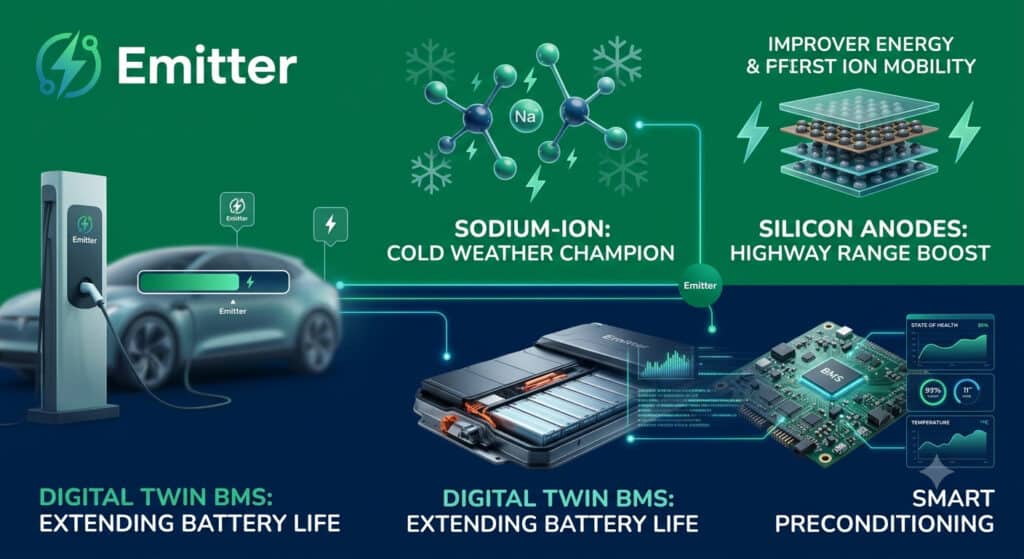
The landscape of EV energy storage is shifting rapidly. As we navigate 2026, battery technology is moving far beyond traditional lithium-ion chemistry. For EV drivers, these breakthroughs aren’t just lab notes—they are changing how fast we charge, how far we can travel in extreme weather, and how we interact with public charging infrastructure.
Let’s break down the major EV battery trends making waves this year and what they mean for everyday drivers.
1. Sodium-Ion Batteries Go Mainstream: The Cold-Weather Game Changer
One of the most defining trends is the commercial scaling of sodium-ion batteries. Because sodium is abundantly available and significantly cheaper than lithium, automakers are adopting it for budget-friendly urban EVs.
-
The Low-Temperature Advantage: Traditional lithium-ion cells can struggle with sluggish charging speeds and reduced capacity in freezing weather. Sodium-ion chemistry maintains exceptional performance even in severe sub-zero temperatures (down to -40°C), retaining high charging efficiency.
-
What it means for your charging routine: Winter drivers will experience less dramatic range drop-offs and far more predictable fast-charging behavior. City-to-city trips in cold climates are becoming much more reliable.
2. Silicon Anodes: The Stealth Upgrade Boosting Highway Range
While next-gen solid-state tech captures headlines for the future, silicon-dominant anodes are delivering massive performance gains in EVs right now.
Traditionally, EV battery anodes are made almost entirely of graphite. Replacing graphite with silicon allows cells to hold significantly more lithium ions, packing far more energy into the exact same physical space.
-
More Energy, Less Weight: By incorporating silicon-carbon composites into the anode, battery manufacturers can boost energy density by 20% to 30%. This translates directly to longer driving range without making vehicles heavier or bulkier.
-
Faster Ion Mobility: Silicon enables faster lithium-ion absorption during high-power charging sessions, reducing overall downtime at charging hubs.
-
What it means for Emitter users: Electric cars equipped with silicon anodes can travel farther between charges. When you do stop, these packs can draw peak power from high-speed DC fast chargers for longer durations—getting you back on the road faster.
3. Semi-Solid and Solid-State Steps Forward
While full mass-market solid-state production continues to scale, semi-solid state batteries and road-tested pilot vehicles have officially hit the streets.
-
Higher Energy Density & Safety: These advanced cells replace or reduce flammable liquid electrolytes with solid or gel-based materials, packing unprecedented energy into compact spaces while improving thermal safety.
-
Ultra-Fast Charging Horizons: With higher energy limits and better thermal tolerance, next-gen architectures are targeting rapid 10% to 80% recharges in 10 to 15 minutes.
-
What it means for Emitter users: As cars capable of taking 300kW+ fast charging hit the road in volume, finding ultra-fast charging locations through your directory becomes key to shaving critical minutes off long-distance road trips.
4. Smart Battery Management Systems (BMS) and “Digital Twins”
Hardware is only half the story. Software is actively redefining how batteries handle real-world charging sessions. Modern electric vehicles utilize Digital Twin technology—virtual software models running real-time sensor data to optimize thermal management and track degradation.
-
Preconditioning is King: Your car’s BMS now actively talks to navigation systems to precondition the battery pack (heating or cooling it to ideal temperatures) before you arrive at an Emitter-listed fast charger.
-
Protecting Long-Term Health: Smart BMS ensures that even if you frequent high-power DC fast chargers, the chemical stress on individual cells is minimized, preserving your battery’s overall State of Health (SoH) over hundreds of thousands of kilometers.
Quick Guide: 2026 EV Battery Chemistries at a Glance
| Battery Type | Primary Benefit | Impact on Charging & Driving Experience |
| LFP (Lithium Iron Phosphate) | High durability & lower cost | Long lifespan, stable performance, excellent for daily commutes. |
| Sodium-Ion | Extreme cold tolerance & affordability | Minimal winter range loss, making sub-zero road trips predictable. |
| Silicon Anodes | Higher energy density in standard packs | Extended highway range and sustained peak charging speeds. |
| Semi-Solid / Solid-State | Maximum safety & ultra-high density | Rapid 10–15 minute pit stops and premium long-range capabilities. |
Looking Ahead
The future of electric mobility isn’t reliant on just one single battery type. Instead, a diverse mix of LFP, Sodium-Ion, Silicon-Enhanced, and Solid-State chemistries are tailoring themselves to different driving needs—from affordable city commuters to long-haul roadsters.
No matter what battery chemistry powers your EV, keeping track of compatible, high-speed charging stations remains essential to a seamless drive.