
Electric vehicles are becoming an increasingly visible part of India’s roads. New EV models are entering the market, charging infrastructure is expanding, and more buyers are considering an electric car for their next vehicle.
However, choosing an EV involves more than comparing the price and claimed driving range. Battery capacity, charging options, charging time, running costs, and access to charging stations can all influence the ownership experience.
Here are some important factors to understand before buying an electric vehicle in India.
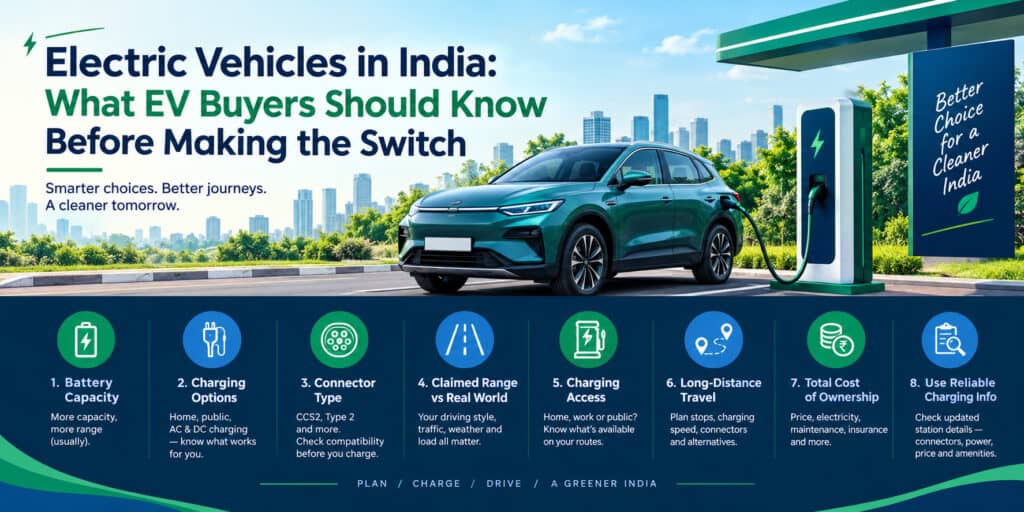
1. Understand Battery Capacity
An EV’s battery capacity is measured in kilowatt-hours (kWh). In simple terms, a larger battery generally stores more energy and can provide a longer driving range, although actual range depends on several factors.
For example, driving speed, traffic, road conditions, temperature, vehicle weight, air-conditioning use, and driving style can all affect energy consumption.
Instead of looking only at the manufacturer’s claimed range, buyers should consider how the vehicle will be used in everyday driving.
2. Know the Different Charging Options
EV charging is not the same as refuelling a petrol or diesel vehicle.
Home charging is convenient for many EV owners, particularly when the vehicle can be plugged in overnight. Public charging stations can be useful for longer journeys or when home charging is not practical.
Charging equipment can broadly be divided into AC and DC charging. AC charging is commonly used for regular or overnight charging, while DC fast charging can charge compatible vehicles much more quickly.
The charging speed depends on both the charger and the vehicle’s onboard charging capability.
3. Check the Connector Type
Different EVs can use different charging connectors. Common connector types in India include CCS2 and Type 2, while other connector standards may also be found depending on the vehicle.
Before using a public charging station, EV owners should check whether the station’s connector is compatible with their vehicle.
This is particularly important when planning longer trips where charging stops need to be considered in advance.
4. Look Beyond the Claimed Range
A vehicle advertised with a particular range will not necessarily deliver the same distance in every situation.
City driving with frequent stops and starts can produce different results from highway driving. Heavy traffic, high speeds and extensive use of air conditioning can also influence consumption.
For practical EV ownership, understanding your regular travel distance may be more useful than focusing entirely on the highest claimed range figure.
5. Consider Charging Access Before Buying
Charging access should be part of the purchase decision.
If you have convenient access to charging at home or at work, regular charging may be relatively straightforward. If you depend mainly on public charging stations, it becomes more important to understand the charging network available around your regular routes.
Before purchasing an EV, consider the locations where you normally travel and identify suitable charging stations along those routes.
6. Think About Long-Distance Travel
EVs can be used for road trips, but long-distance travel requires more planning than a typical fuel stop.
A useful trip plan should consider the distance between charging stops, available charging connectors, charging power, expected charging time and alternative charging locations.
It is also sensible to avoid planning a journey around a single charging point. Having alternative charging options can make the trip easier if circumstances change.
7. Compare the Total Cost of Ownership
The purchase price is only one part of the cost of owning a vehicle.
EV buyers should consider electricity costs, charging expenses, maintenance, insurance, financing and expected usage over several years.
Electric vehicles have fewer moving components in their powertrain than conventional internal-combustion vehicles, but maintenance requirements still exist. Tyres, brakes, suspension, air-conditioning systems and other components continue to require attention.
8. Use Reliable Charging Information
As India’s EV ecosystem grows, information about charging stations is becoming increasingly important for EV owners.
A charging station directory can help users discover charging locations and understand details such as charger type, connector type, charging power, pricing, operating hours and available amenities.
However, station information can change over time. Users should check the latest information available from the relevant charging network before starting an important journey.
Final Thoughts
Buying an electric vehicle is a decision that should be based on how the vehicle fits your everyday driving needs.
Battery capacity, practical range, charging compatibility, charging access and ownership costs are all important considerations. For buyers who regularly travel longer distances, planning charging stops can be just as important as choosing the vehicle itself.
As India’s EV ecosystem continues to develop, understanding both the vehicle and the charging infrastructure can help buyers make more informed decisions.